
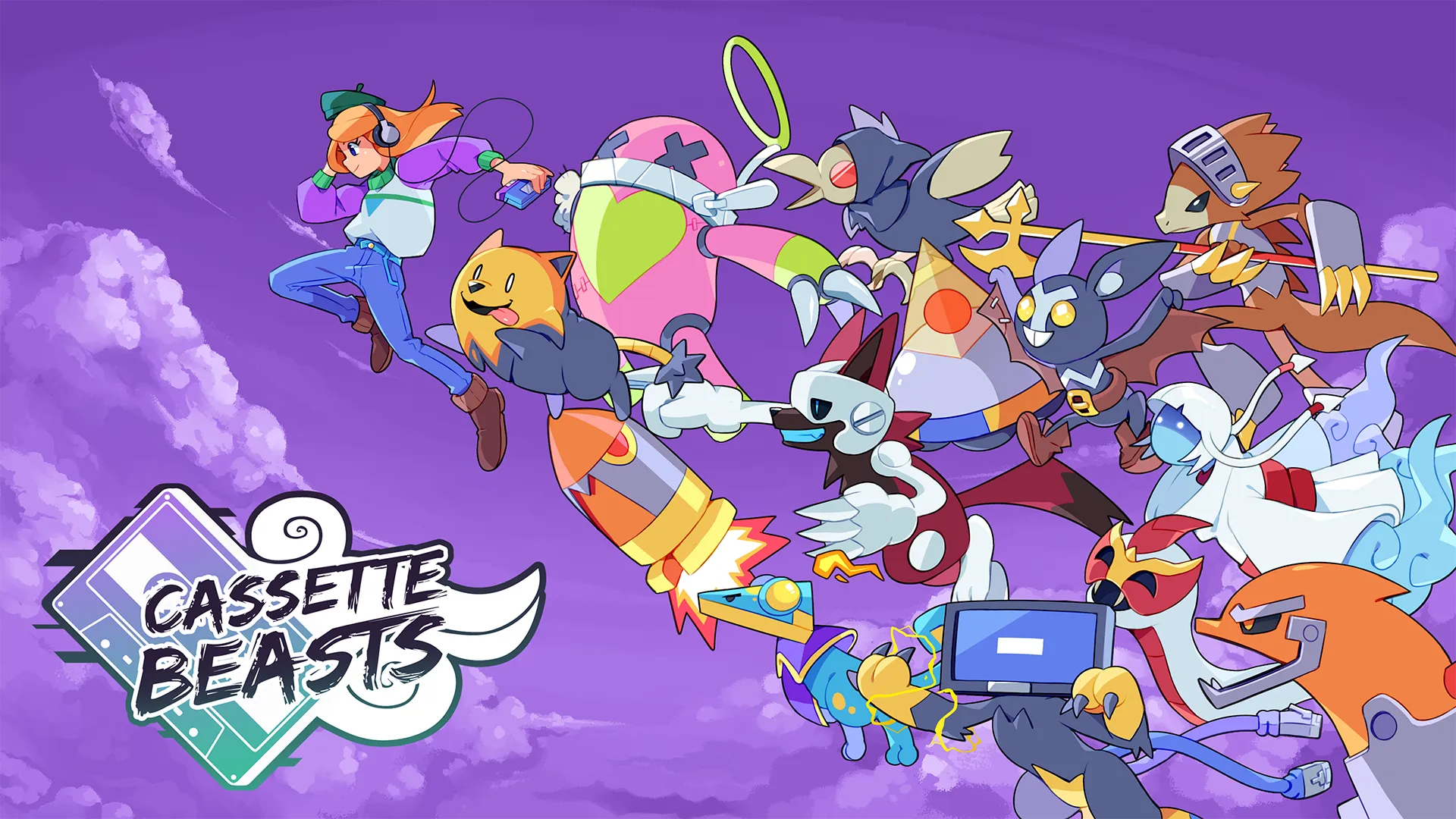
Cassette Beasts
A remaster of its genre
Developer: Bytten Studio
Publisher: Raw Fury
Released: April 23, 2023
Platforms: Steam, Nintendo Switch, Xbox One, Xbox Series X/S, Mobile
Platform: Steam
Difficulty: Hard
Completion: Main Story + DLC
I’ve been an on and off fan of Pokémon since I entered the series with Y Version in 2013 — what initially got me into the creature collectors subgenre. Since then I’ve wandered the genre looking for something that hit the same way, with mixed results. ATLUS’ Shin Megami Tensei properties have served to fill the space, even if calling it “like Pokémon” would be reductive at best; it’d be more like Pokémon is like SMT. It’s clear that many take directly from Pokémon, but do so without understanding the original draw of these games — or worse, treating them like something that needs to be fixed. Cassette Beasts feels like the rare exception: clearly inspired, but made in love rather than in spite.
Rather than catching and summoning creatures, you record them onto cassette tapes and transform into them yourself. Every battle pairs you with a partner character, each with their own signature beast and enough personality to make you actually care who’s fighting beside you. The battles don’t replicate Pokémon’s mechanics so much as they replicate the feeling of learning them for the first time. They’re simple on the surface, yet go so much deeper once you’ve had a closer look.
The beast designs feel like they were built for New Wirral specifically. They’re all grounded in a consistent logic that gives the roster an identity of its own. They’ve made the controversial decision of offering an undead and a candy-themed option among your starters rather than the classic fire/water/plant trio. The very first creature both encountered and conceptualized, Traffikrab defines the direction of the roster. It takes something as mundane as a traffic cone and builds a complete, convincing creature around it. And even as a glorified tutorial enemy, Traffikrab has attack animations distinct enough to make each attack option feel unique rather than generic. Robindam follows a similar idea. It’s a blend of Bandai’s Gundam and the Robin Hood legend, with a design that lands somewhere close to Gundam’s iconic antagonist suit. It leans into its archer theming with a skill that ensures every attack is ranged. I believe that might be the reason I like it so much, it manages to stand out more in a sea of uniqueness.
![[A battle with Traffikrab]](/_astro/traffikrab.CHU1AfQc_EkFu4.webp)
By far the most interesting piece surrounding the beasts and combat is its elemental system. The game quickly makes it clear that it’s different from what Pokémon and Shin Megami Tensei might have conditioned, in that type advantages are in the form of elemental reactions rather than rock-paper-scissors relationships. There are also some unconventional typings, Traffikrab and Robindam come from the ‘Plastic’ type which covers beasts built around synthetic materials and toys — Traffikrab’s traffic cone shell being the most literal interpretation of the type you’ll find. A system like this had me thinking more deliberately about how I prepared for a fight, as there were times where just having a “type advantage” wouldn’t mean what it would in other games. Hitting ice with fire would just create a bigger problem as it now “melts” into a water type. I was more likely to think about typing and species defensively than I was in Pokémon, because the impact of them is more easily felt.
A gripe I had with the system is that some types didn’t really have “bad” matchups, or they didn’t have any that mattered. The Astral type could disrupt a good amount of common types making it one of the most useful ones deserving their rarity, but two of their weaknesses give berserk which I found didn’t affect much. Plastic deals a similar disruption to it, but I found these types were barely present throughout the game. Overall I wouldn’t consider this a total failing, Pokémon’s dragon type was like this for years, but it did reduce my incentive to continue innovating after I realized the quirks of the game’s roster. Reactions are vast, and each one will only be explained to you once by default so they can be hard to remember. The game provides a guide you can pull up mid-battle that covers most of what you need. It reminds you what each reaction does in practice, but stops short of the hand-holding the tutorials offered.
Your moves are handled through applying stickers to your tapes. Each tape holds a set number, and moves fall into melee, ranged, status, or passive categories. Passives have the greatest potential of the four, and nothing stops you from stacking duplicates. A passive that triggers on a condition can trigger multiple times in a single turn with enough luck, which is where most of the game’s cheesiest strategies come from. I love this quirk, though it does make other approaches feel less viable once you’ve discovered it.
![[A Beast with five pre-emptive strike stickers.]](/_astro/exodia.BsfelIfk_Z20v5Fq.webp)
What drew me in most, though, was fusion. After spending enough time with a partner, both your beasts can combine into one that directly merges the strengths of both. Having entered the genre through X and Y, I have a soft spot for this — Mega Evolution carried that same sense of spectacle, that feeling that something significant was happening on screen. Each fusion design is entirely unique, and while the game rarely demands you use them, I found that restraint made the mechanic feel special rather than routine.
The world itself is traversed through a 2.5D perspective. Entering new areas feels like a puzzle at first, but gradually as you record more beasts you will unlock abilities aiding in your exploration. Cassette Beasts is one of those games that take full advantage of the pixelated art style, the sprites are expressive enough to carry personality without demanding the budget of a larger production, and the environments have a texture that makes New Wirral feel lived in despite their simplicity. The game’s physics lends a jankiness that I think grants it a type of “indie charm” more polished games couldn’t get away with. Overworld objects may be sent flying, enemies can fall off the map, and my partner can struggle to catch up to me at times. The overworld puzzles are one of the weaker points — they range from solving themselves to being genuinely obtuse in ways the game doesn’t adequately signal.
Exploring New Wirral there are a few different types of encounters you’ll stumble across. There are 12 Ranger Captains which effectively act as gym leaders. Narratively, not much would be lost if they were removed as most fall cleanly into archetypes of well-mannered, enthusiastic, asocial, or stoic without much beneath the surface. Mechanically though, they offer challenges true boss encounters are too eccentric to give. I believe they make up for this with interesting gimmicks and mechanics that go beyond “type specialist,” I’m even happy to say I’ve actually stolen strategies from them which is more I could say of any other game even beyond this specific genre.
Your primary targets throughout the game are the Archangels, who are unrecordable monsters that only follow a select few rules of combat. They rarely use any actions capable of generating reactions, and rather possess unique gimmicks for the player to react to. What I like most about them, though, is their designs. They’re made in a way that would clearly look nonsensical in a pixelated world like New Wirral — some appear hand drawn, others like collages. Each fight is unique and something I wish I got chances to endlessly replay if not for the need to progress the story.
![[The Archangel, Morgante]](/_astro/archangel.BUjYjgYp_Z1a0qK3.webp)
The partners you travel with are where the game’s writing shows its hand. Each one is distinct — in their story, their personality, and their signature beast, making it likely that at least one will resonate. The partner I found myself returning to most was one I related to personally, though I suspect others will find their own reasons to feel the same way. I’d like to compliment the game on the design of each of their signature tapes as almost all of them feel like something I’d want in my own party if they were natural encounters instead. The broader cast carries that same lived-in quality as the environments, memorable enough to make New Wirral feel populated rather than empty, without demanding the kind of attention the partners do. Those who find satisfaction in incidental character moments will get plenty here. Those looking for complexity in every exchange probably won’t.
Fittingly for a game built around cassette tapes, the music might be its best quality. Battle themes in particular never wore out their welcome across the entire campaign. The vocals that accompany fusion have more potential to tire, which I think quietly justifies how rarely the game demands you fuse. If you love them enough to want more though, mods exist in the steam version to have them play in every battle.
B-Side
This game recaptures what it was like to open up a Pokémon title for the first time. It’d be dishonest to call it a clone, but the spirit of what originally caused me to fall in love with the subgenre is all there.
It expands upon the typical mechanics of creature collectors by foregoing the rock-paper-scissors formula of elemental systems for elemental reactions that add depth to battles. Fusions add spectacle on top of all of it.
Beyond battles, I enjoyed interactions with companions. Meredith in particular resonated with me as I relate to how she reacted to the situation she was put in. I’m glad I played this for the soundtrack, I was shocked by the impression it left on me for an indie title of this scale that I wouldn’t expect to have such impactful themes. I was obsessed with it when I first played on Xbox Game Pass and I still am.
I’d recommend this to any Pokémon fan — it represents everything I’ve been looking for in the subgenre. The open world traversal can be irritating and the storytelling is simple if thoughtful, but neither gets in the way of a genuinely wonderful game.
If Pokémon allowed me to date my rival/10
Discussion
0