
Motorslice
A Slice of P
Developer: Regular Studio
Publisher: Top Hat Studios, inc.
Released: May 5th, 2026
Platforms: Steam, PS5, Xbox Series X/S, PC Game Pass
Platform: Steam
Completion: 100%
OS: Windows 11
CPU: Intel Core i7-13650HX
GPU: NVIDIA GeForce RTX 4060 Laptop GPU, 8 GB VRAM
RAM: 16 GB
This was another one I had been anticipating for a while before its release, but somehow it didn’t clock that it was a parkour game until I actually played the thing. With the NieR: Automata comparisons I expected something else, but you know what they say about assuming.
As it turns out, the two games share a strikingly similar initial premise when looked at: An unknown, barren land infested with rogue machinery. Our protagonist, aptly titled ‘P’ and even shares her voice with 2B, is tasked with eliminating each one. It was well-established in the demo how squishy P is compared to the androids of Yoko Taro’s classic, with her getting torn apart by even a single hit. In the full game you’re afforded a second chance in certain cases, though death is never far. From the start this is a game that rewards deliberate play rather than button mashing action.
![[descriptive alt text]](/_astro/motorsliceHero.9YGkVs8E_Z1ykw52.webp)
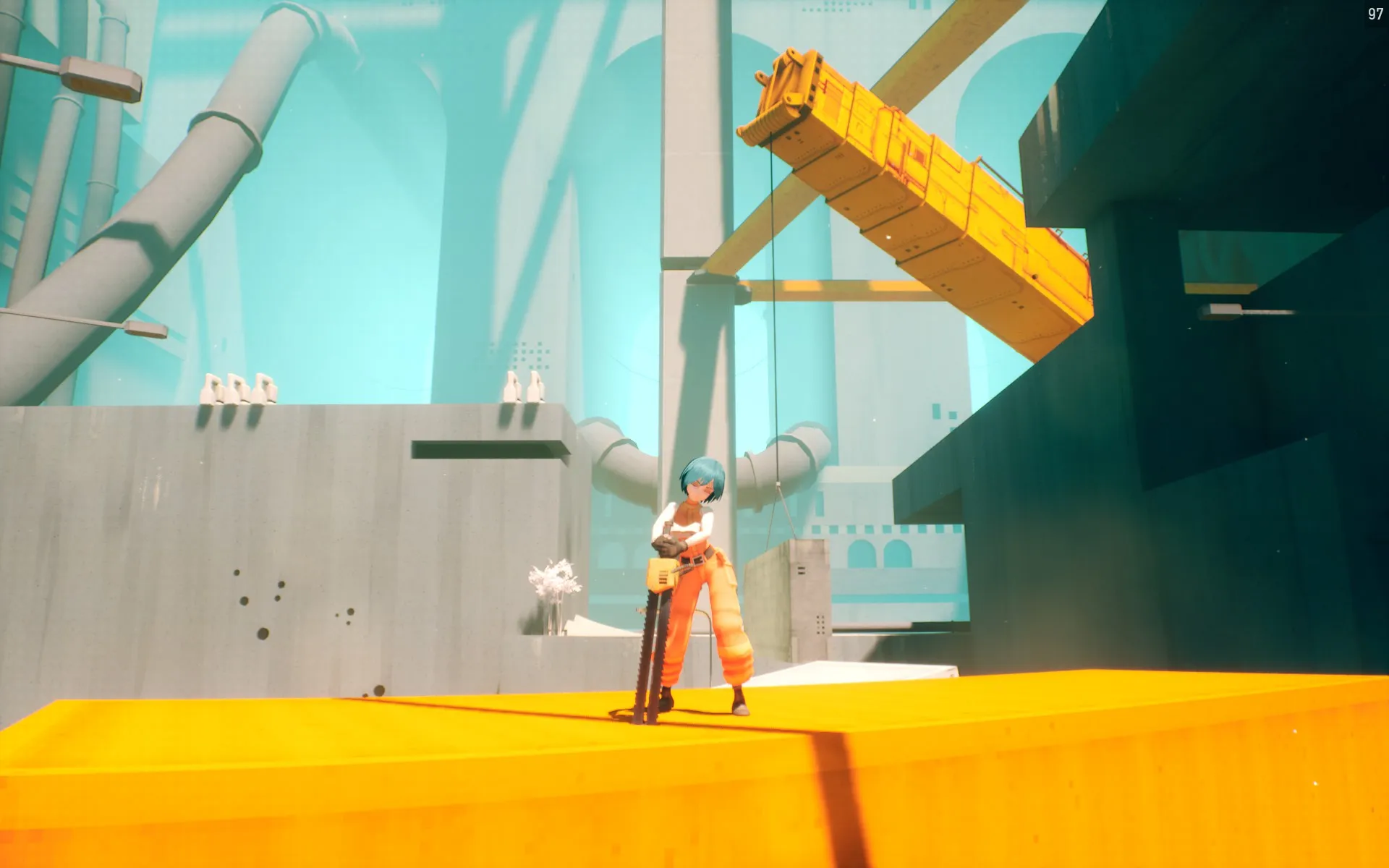
You’re quickly made to realize what you see is what you’ll be getting. You’re thrust into more lifeless desert with each chapter, and the higher up the vast structure you go the farther the promised peak seems. Motorslice is oppressive in its environmental design, as each door thrown open will inevitably lead to more of the same vast indifference. Regular’s level design pushes feelings of isolation onto the player, to the point I found myself having to close the game for entire days due to claustrophobia and the dread some sections harbored. It’s the natural-born fear not of the dark, but of the fact anything could be lingering within it.
The game employs a sometimes lost art of utilizing silence, or more precisely lack of music during most of the game. All you get is subtle ambience until upbeat tracks play once machines are in sight. The silence adds to the atmosphere rather than detracting, and when music finally kicks in it signals danger before you’ve even spotted anything.
![[descriptive alt text]](/_astro/goddammit.jj-i_B9L_Z2akTgS.webp)
As the player, your actual “perspective” comes in the form of the drone that hovers around P, which she’s named Orbie. Being its own entity, P can interact with it during gameplay —there was more than one time when I’ve died due to P stopping to rudely smack it away after I got too close. My favorite part of this feature, however, is the ability to have P pick up Orbie for the opportunity to take selfies. On its own the feature is barebones, but I regularly found myself entering selfie mode simply because of a beautiful background or being in a safe spot to capture an enemy in a silly pic.
The game at times lets you take a break to “slack off” with P. It is during these scenes that you can really see how she’s begun to personify Orbie either due to the isolation of her mission or because of a naturally whimsical side of her personality. Here you can learn about the world, P herself, and her workplace. The thing that always struck me the most about her is how nonchalant she is about her situation, and I was left wanting to learn more about what she’s been doing before to motivate such an attitude. A small touch I appreciate is how much faith the writers of the dialogue had in the player to piece together key words such as “reset” that P clearly understands but the game never bothers to define for you. By withholding, they actually add to their storytelling.
![[descriptive alt text]](/_astro/sand.PUTU8nE8_Z1IFMxD.webp)
The hallmark of the game is parkour sections, which makes it more similar to that subgenre of platformer rather than any character action. You’re tasked with guiding P through narrow corridors and around persistent traps, where failure almost always meant death. Sections can range from relaxingly satisfying to demanding of precision, but a great thing about the system is having the consequence of creating multiple means of moving forward (even if that also meant players could skip entire chapters at launch). This was my first real dive into the parkour genre, and this game certainly gave a good first impression despite my difficulties.
![[descriptive alt text]](/_astro/miss.DXZMSUH8_Z1Mz4Mc.webp)
A point of contention worth addressing is the game’s approach to the controls, particularly related to parkour. A common complaint is inconsistency in P’s movements when attempting certain actions, as well as controls feeling “floaty”. I can see where they’re coming from, she’ll sometimes climb when I need her to wall run and jumps felt like leaps of faith more than I’d expect Regular intended. Trial & error became a common routine, but nevertheless it was possible to adjust to the game’s jank. From my experience the controls for the most part were not much of a hindrance after getting used to what the game was demanding of me, although as more complexity was introduced I could admit that I had to step away a few times. Given my FromSoftware allergy it’s bold of me to throw around “skill issue,” but I do think most of the hurdle is skill curve. If anything, the experience has made me appreciate the idea of overcoming a challenge as its own form of enjoyment more.
This is where I put a disclaimer for my completionists, as I cannot in good faith recommend this to them if they’re the types to become obsessive with completing every objective in their games. Motorslice features a collectathon, and while achievements only require you to acquire around 30, there are many more hidden behind difficult trial-and-error parkour challenges. The intent of the rest is allegedly only for an extra challenge, but in the attempt to complete them I feel it actively hindered my enjoyment of the middle chapters of the game before I decided to leave the rest behind after getting enough for the 100%. For seasoned parkour veterans, they’re a welcome layer of challenge in a mostly linear experience. But for anyone else I recommend sticking to the set path.
You’re dealing with aggressive, rogue machines that can kill you easily if you’re not careful. The theming of your enemies is heavily centered around construction equipment, with the main opponent from the demo being tiny excavators. There’s not too much to say about the enemies of Motorslice, as the variety is particularly limited and difficulty scaling came from combining enemy placement with platforming hazards. Most enemies will kill P with one hit, so positioning is essential, although the same goes for them where a clean shot is enough to get rid of them. There are a select few, however, that require a different approach.
In each of the game’s chapters a large machine wanders the stage, waiting for the player at the end. Referred to by P as ‘Elders,’ a four-inch chainsaw might not be enough to deal with them alone, so P must resort to the Shadow of the Colossus method of scaling the behemoths and chipping away at them. She does this through the game’s ‘Motorslice’ mechanic, using your saw to climb and literally carve at them piece by piece. Each of the game’s bosses presents a new challenge testing the player on what the level itself should have taught them, be it the Motorslice itself, using the environment to their advantage, or purely quick thinking when caught by surprise.
My favorite tool against the machines is the ability to parry, which while not as prominent as it is in other games that include it, feels satisfying whenever it comes up. While the game expects you to primarily use it against enemies, in theory just about anything that could damage you is parryable with the right timing. This includes traps, allowing P to push back massive grinders or deflect flying buzzsaws. But the best part by far is stunning elder machines by parrying at the correct moment.
![[descriptive alt text]](/_astro/RulesOfNature.D8cd7KV-_Z7xyVn.webp)
Nevertheless, the bosses of Motorslice are also where the game’s jankiness becomes hardest to ignore. I remember having to take multiple breaks from one of them due to their mechanic being frustrating to pull off, often because of it not exactly working in a way that immediately makes sense. And it happens early enough that most might not beat themselves up over quitting but late enough that those that like the game would feel the need to press on. What you actually have to “do” is usually clear, but the means to do it might not immediately feel adequate to those coming in fresh.
It’s peak.
I was a bit hesitant with this one after struggling with the demo since this is my first time giving an actual parkour game a shot, but somehow I found myself enjoying the experience for what it is.
The game really captures the isolating feeling of being stuck in a wasteland with no contacts, and for once it was thrilling to have my claustrophobia trigger regularly while playing. P herself is an entertaining protagonist for the situation she’s placed in with the way she reacts to the type of stuff I’d have a panic attack over.
If you can get past the skill curve with the controls, Motorslice is a brief but enjoyable experience despite its frustrations. I was astonished at the level of quality that was packed into a game that didn’t even cost my system 1 gigabyte.
That being said, I can’t in good faith recommend this game to completionists, as those damned orbs actively hindered my enjoyment of the game while I obsessed over collecting each one all at once. Casuals like myself will have a much better time playing from point A to B.
Despite the games being different I am confident that some corners of NieR’s fanbase will enjoy this game if only for the protagonist alone. Ya freaks.
Who put Kojima in charge of art direction/10
Discussion
0